
Plan A: Ο Πλανήτης μας
Climate change is a growing concern for our customers and colleagues, and we saw this amplified with COP26 in the UK.f
To reflect the climate emergency we all face, we reset Plan A with a singular focus on becoming a net zero business across all our operations and our entire value chain by 2039/40 – ten years earlier than the Government’s UK-wide strategy. We’ve set interim targets for 2025/26, 2029/30 and 2034/35 and a clear roadmap to move towards delivering these goals. Our targets align with the aim of the Paris Climate Agreement to limit global warming to 1.5°C and we’ve joined the UN’s Race to Zero campaign.
We have established an ambitious roadmap identifying the ten immediate priority areas we will focus on as we make our journey towards net zero.

100% of soy to be sourced from verified deforestation and conversion-free regions by 2025/26.
100% segregated responsibly sourced palm oil by 2025/26.

100% verified recycled polyester by 2025/26.

We support our farmers to enable them to grow low carbon, responsible food, use fewer pesticides, enhance their soil, protect natural resources and drive innovation.

Double the sales of vegan and vegetarian products by 2024/25.

Looking beyond our own operations to spark change and support decarbonising across our full value chain.

Enhancing our clothes recycling scheme with new incentives for Sparks members.

100% edible surplus to be redistributed by 2025/26.
Food waste reduced by 50% by 2029/30.

100% of packaging to be recyclable by 2025/26.
Remove 1bn units of plastic packaging 2027/28.

Deliver a more efficient store estate.

Moving to low-carbon logistics with reduced dependency on diesel and increased use of new technologies and cleaner fuels. Contributing to cross-industry action through collaboration.
We know that 94% of our carbon footprint (6.1 million tonnes) comes from indirect, or Scope 3, emissions. These indirect emissions come from our value chain – how we make and source our products. Only 6% (0.3 million tonnes) of our carbon emissions come directly from the fuel and electricity we use in our operations (known as Scope 1 and 2 emissions). As an own-brand retailer, we are uniquely positioned to work with our trusted suppliers to reduce Scope 3 emissions. One of our biggest strengths is the close and long-lasting relationships we’ve built with our partners, from farms to factories.
This year we have had our 2030 corporate greenhouse gas emissions reduction target approved by the Science Based Target initiative:
“Marks and Spencer PLC commits to reduce absolute scope 1 and scope 2 GHG emissions 55% by 2030 from a 2017 base year. Marks and Spencer PLC also commits to reduce absolute scope 3 GHG emissions 55% within the same time frame.”
The target was set and the baseline updated in line with current guidance.
The impact of climate change affects all of us and the scientific evidence is clear – urgent action is needed by everyone. Every human activity has a carbon footprint. We all need to cut emissions to avoid the worst consequences of climate change. And there are practical considerations for our business: energy costs, the availability of raw materials, new markets and new legislation.
With the reset of Plan A, our singular focus is to achieve net zero in our own operations and across our entire value chain and products by 2039/40.
To ensure we are on the right trajectory to meet our SBTi approved target in 2030, we set an interim goal to reduce our emissions by 34% by 2025/26 which equated to a 2.1 million tonne reduction.
All of the ten work streams that make our Net Zero Transition Roadmap have been mobilised across the business. Management is monitoring progress towards our carbon reduction targets via our ESG Business Forum on a quarterly basis. We have a clear line of sight, based on projects that are underway, to 62% of the 2.1m tonne emissions reduction we are committed to deliver in 2025/26.
Our operations
In 2022/23, our focus across our stores, warehouses and logistics footprints has been on driving efficiencies, reducing waste, improving our greenhouse gas emission measurement and tracking capability and investing in our store estate for the future. In September 2022, we acquired Gist, our Food logistics provider, a move that allows us to accelerate our plan to modernise our Food supply chain network to support growth.
We have driven a 32% reduction of total Scope 1 and 2 location based greenhouse gas emissions, against 2016/17 base year. This year we have seen a 3% reduction of total Scope 1 and 2 location, based greenhouse gas emissions, against 2021/22.
Reductions were driven by a fall in reported emissions from refrigerant leakage, which were down 18% on last year, caused by a return to normal levels of maintenance visits to top up refrigerant, following a
spike the previous year, when maintenance visits resumed post-Covid lockdowns. Emissions from purchased electricity also reduced and were 4% down on last year.
Our supply chain
A significant part of the 2.1m tonne reduction in 2025/26 will come
from how we source, make and sell our product. This year, highlights of our progress including our reduction in food waste, removal of plastic packaging, an increase in soy sourced from verified
deforestation and conversion-free supply chains, and an increase in the volume of recycled polyester sourced in clothing.
To make net zero a reality, working with our stakeholders will be crucial. This is why we have designed our roadmap towards net zero as a multi-stakeholder plan that includes customers, colleagues, supplier partners and industry partners to help deliver the emissions cuts needed across our whole value chain, from the raw materials we use to how our customers use our products.
We know we can’t achieve net zero if we don’t work with our customers to help them live lower-carbon lives. We also know from our latest M&S Family Matters Index report that the environment and climate are issues that matter to our customers.
We’re inviting our customers to Look Behind the Label and discover the sustainability stories behind our products. In our new Look Behind the Label hub customers can dig a bit deeper to discover the steps we’re taking to protect the environment when sourcing some of their favourite products. This year we launched Sparking Change, run in partnership with behaviour change experts Hubbub to help our Sparks customers prepare more sustainable meals from scratch.
We’ve worked with Reboot the Future, a not-for-profit organisation that works with young people and business leaders, to create resources that encourage customers to start conversations about climate change and to make it easier for them to discuss the challenges and opportunities of living lower-carbon lives. These resources are available for free here.
Reducing our carbon emissions is not something we can do alone. The achievements of Plan A to date are thanks to the efforts of our colleagues, who we know are passionate about building a sustainable future. We’ve started by improving carbon literacy across our business, giving colleagues a greater understanding of the emissions associated with how we source, make and move our products.
Through our partnership with WWF, we’ve been inviting colleagues to assess their personal environmental footprint using WWF’s environmental footprint calculator. So far, around 1,000 colleagues have used the online tool to understand their environmental impact and view actions they can take to reduce it.
We’ve identified 100 colleagues as ‘Carbon Champions’. They work in key roles such as buying, sourcing and logistics and will help activate our net zero transformation across different areas of our business. By building knowledge across these teams, we can take action quickly to reduce emissions. We have also established a Plan A Network, giving our colleagues space for discussion, engagement and learning on climate change. The network now has over 1,800 members from across stores, support centres and distribution centres.
In Fashion, Home & Beauty we have a Sustainability Academy to support our product development colleagues and teach them about sustainability topics, such as circular fashion, animal welfare and sustainable sourcing.
No one business can solve all the sustainability challenges that lie ahead, which is why we work with trusted supplier partners and organisations in the industry to help us innovate and adapt to our changing environment.
As a starting point, we’ve asked all of our Food suppliers to commit to our ‘six key asks’. These include:
- setting a science-based, 2040 net zero target and roadmap for Scope 1, 2 and 3 emissions;
- purchasing 100% renewable electricity;
- purchasing verified deforestation- and conversion-free animal feed;
- focusing on packaging quality, innovation and sustainability, and removing plastic where possible;
- and implementing a food waste redistribution plan.
In our Fashion, Home & Beauty supply chain we’re supporting our tier 1 and tier 2 suppliers to reduce their carbon emissions. We use the Higg Index Facility Environmental Module (FEM) as a standard measurement of supply chain sustainability which helps us track improvements in our supply chain environmental performance. We use data from the Higg FEM to help develop our supply chain programmes within our clothing categories and to support supplier partners to reduce the greenhouse gas (GHG) emissions of their facilities. It also helps us to understand complex environmental metrics such as chemical management, air emissions and wastewater.
Our collaboration with key partners across the retail industry includes working with:
Better Cotton,
the British Retail Consortium,
Canopy,
Cascale,
LEAF,
Leather Working Group,
Textile 2030,
WRAP
and WWF.
We are also a member of the Science Based Targets initiative’s Business Ambition for 1.5°C, the UN’s Race to Zero campaign and the British Retail Consortium’s Climate Roadmap.
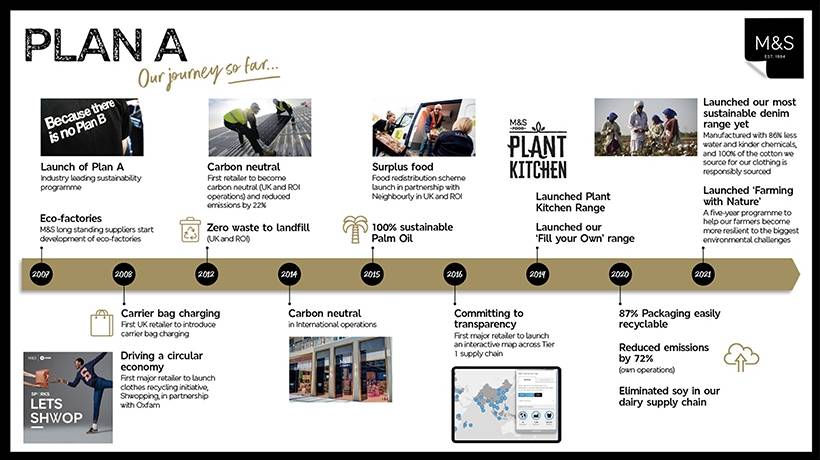
We first launched Plan A in 2007 and have been working to reduce our impact on the planet ever since. We were the first major retailer to become carbon neutral in our own operations back in 2012, but the scale and urgency of the climate crisis means it’s clear we need to do more. Our response has been to reset our Plan A sustainability programme to have a singular focus on becoming a net zero business across our entire supply chain by 2039/40.
The TCFD has developed a framework to help public companies and other organisations more effectively disclose climate-related risks and opportunities through their existing reporting processes. From 2021/22, M&S was required to adopt the listing rule for UK premium-listed companies to include a statement in their annual financial report setting out whether their climate-related financial disclosures are consistent with the recommendations of the TCFD. The TCFD recommendations provide a framework of four core elements around climate-related risks and opportunities that companies must report on, namely governance, strategy, risk management, and metrics and targets.
As outlined in our approach to risk management, climate change and environmental responsibility is a principal risk to our business. We are committed to managing and disclosing the risks involved in line with the recommendations of the TCFD. Our climate disclosures in line with these recommendations can be found on page 44 of our Annual Report.
We have relaunched a £1 million “Plan A Accelerator Fund” to support projects that address challenges and support innovation that will help us reduce emissions. We’re working with our long-term supplier partners and business partners to focus on key areas where we’re well placed to make a difference – from improvements in our store operations and distribution centres, to piloting new materials in fashion and exciting partnerships on recycling.
In December 2021, we agreed a new £850m revolving credit facility, directly linked to the delivery of net zero targets. Under the terms of our new facility, which will run to June 2026, we will benefit from a lower interest rate for delivery against four metrics that deliberately focus on material emissions hotspots aligning to our roadmap towards net zero and to areas of customer concern.
A summary of our metrics can be found below.
- 100% of polyester sourced from verified recycled sources by 2025/26.
- 100% physically certified deforestation- and conversion-free soy by 2025/26.
- Scope 1 and 2 emissions reductions in UK and ROI property (annual reduction/tonnes CO2e).
- Removal of plastic packaging units per year from the company’s packaging portfolio.
The related assurance opinion will be published in supplementary sustainability reporting later this year.
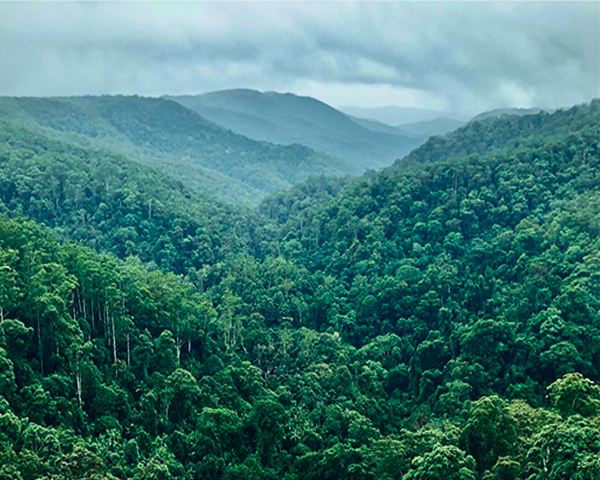
We aim to exclude deforestation from our own supply chains while working with others to promote good land management and sustainable production practices at a landscape level.
Rainforests store the most carbon by area, are of most value to disadvantaged communities, and contain greater biodiversity than almost any other type of forest. Yet these are the forests mankind is depleting most rapidly year on year, as the result of illegal or badly managed logging and land conversion for agriculture, including the cultivation of soy, palm oil and cattle.
M&S recognises commodity agriculture as a major contributor to forest loss, with a large proportion of tropical forest loss being associated with palm oil, soy and wood-pulp plantation development and cattle ranching.
However, these commodities can also play a valuable role in promoting sustainable livelihoods, agricultural productivity, and good land management, so we do not believe prohibiting their use is the best way to address deforestation.
The demand for timber is expected to triple by 2050, which will make it increasingly difficult to obtain. Wood is an essential commodity for M&S. It provides the base material for many of our products – most notably furniture, but also many others, including tissues, hairbrushes and greeting cards. We couldn’t package our products, even run our business, without wood materials, so we appreciate the vital importance of forests and timber plantations.
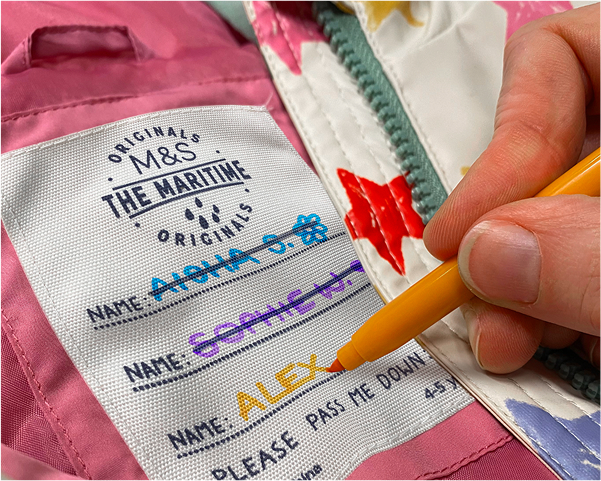
As part of our net zero by 2040 strategy, we’ve identified ‘Circular Economy’ as one of our 10 key pillars. We are working across our value chain to drive circularity and reduce waste in key areas such as used clothing, food waste, packaging, and carrier bags.
We’ve started our transition to new circular business models, by improving the recyclability of our packaging and goods, increasing the durability and use of recycled materials in our products, and introducing refill and reuse options for customers. We support the transition to a circular economy and will prioritise business model innovation, working with our partners to put circular ways of working into practice.
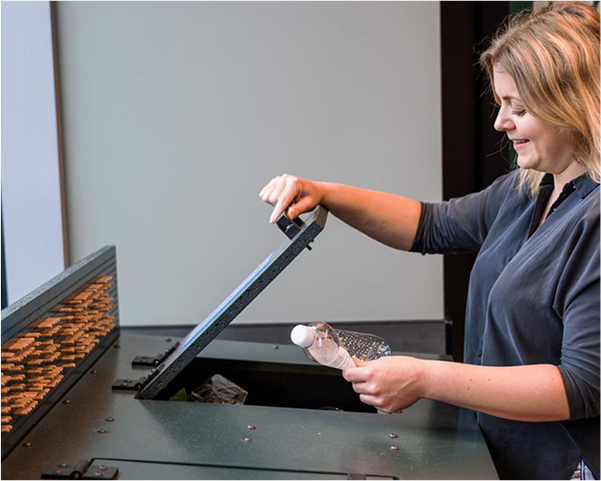
We are playing our part in reducing single use plastic and pressing the accelerator on closed-loop recycling.
To help us work towards net zero, a circular economy and closed-loop recycling system we’ve set the following targets:
- 100% of our packaging to be recyclable by 2025.
- In Foods, we want to remove 1bn units of plastic by 2027, equating to a 30% reduction in the volume of plastic food packaging.
In 2021, overall, a higher percentage of our packaging was recyclable than ever before, at 91%, up from 87% the previous year.
The year on year improvement was greater for plastic packaging specifically, which increased by 11% in 2021.
This is following the rollout of our plastic takeback scheme to more than 500 stores this year, which means customers can now easily recycle more of our plastic packaging, including ‘soft’ plastics that aren’t typically collected for recycling by UK local authorities, such as bags, films, pouches and wraps.